AirPods
AirPods is the category that was born inside John Ternus's hardware division in 2016. By 2025, AirPods alone produces more annual revenue than the entire Roku ecosystem — and it's the clearest case of 'new category, well executed' from the post-Jobs era.
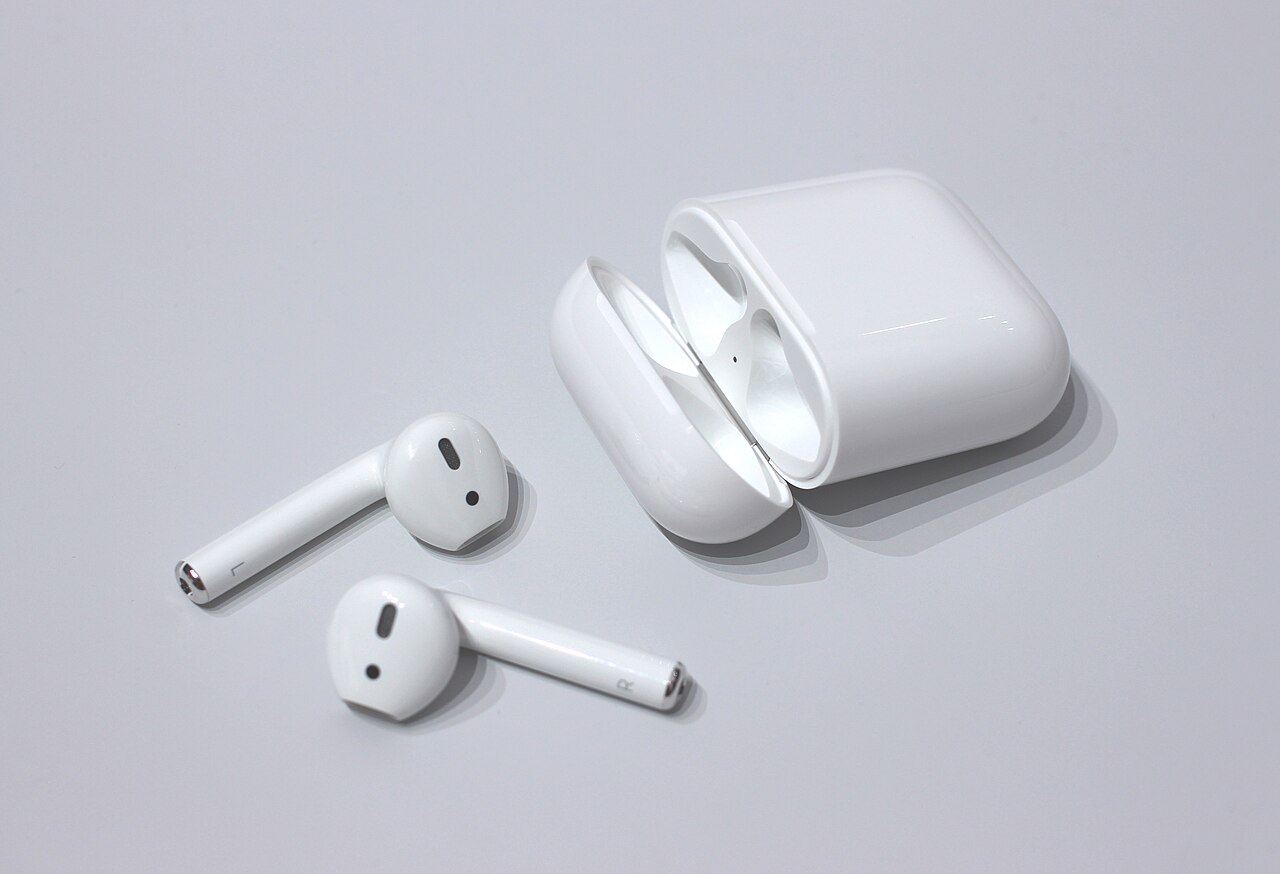
The AirPods were announced on September 7, 2016, alongside the iPhone 7. At that moment, John Ternus had been VP of Hardware Engineering for three years under Dan Riccio, and the AirPods division reported to him. AirPods were born inside Ternus’s portfolio.
Ten years later, AirPods alone produces more annual revenue than the entire Roku company — a conservative estimate puts AirPods at $18–22 billion/year, when Roku does about $4 billion. It’s the clearest “new category, well executed” case of Apple’s post-Jobs era, and it’s the product that structurally validates the thesis of a capable hardware division.
The 2016 bet — delivered via removing the jack
The AirPods launch timing was tactical. September 2016 was when Apple removed the headphone jack from iPhone 7. The controversy was massive — “Apple is killing the jack to sell AirPods” — but the bet was direct. Apple was doing two things simultaneously:
- Force the transition to Bluetooth audio in a category where the industry was stuck on adapters.
- Differentiate the ecosystem with instant pairing via the W1 chip (later H1, H2) that other Bluetooth headphones could not replicate.
Anyone who bought iPhone 7 without AirPods felt friction. Anyone who bought both got the first wireless audio experience at consumer scale. Apple normalized Bluetooth headphones across the entire consumer market in three years.
AirPods product cadence
| Model | Launch | Milestone |
|---|---|---|
| AirPods (1st gen) | b.2016.09.07 | Category debuts. W1 chip, 5-hour battery. |
| AirPods (2nd gen) | b.2019.03.20 | H1 chip, “Hey Siri”, 50% more standby. |
| AirPods Pro (1st gen) | b.2019.10.30 | Active noise cancellation (ANC). “Pro” tier debuts. |
| AirPods Max | b.2020.12.15 | Premium over-ear headphones. $549. “Max” tier debuts. |
| AirPods (3rd gen) | b.2021.10.18 | Spatial Audio in regular AirPods. |
| AirPods Pro (2nd gen) | b.2022.09.07 | H2 chip, 2x better ANC, USB-C (later). |
| AirPods (4th gen) | b.2024.09.09 | ANC in regular AirPods, first time. |
| AirPods Pro 3 | b.2025 | Health sensors (temperature, heart rate). |
The W1, H1, H2 chips — the silent infrastructure
The under-narrated history of AirPods is that it introduced an entire family of Apple custom chips running in parallel to the iPhone’s A-series chips:
- W1 (2016) — first Apple custom chip for wireless audio. Instant pairing via iCloud.
- H1 (2019) — replaced W1, lowered latency, added “Hey Siri”.
- H2 (2022) — doubled ANC, added new conversational sound, lowered latency further.
This chip family is the “wearable” counterpart of the A-family (iPhone), the S-family (Watch), and the M-family (Mac). Ternus ran the whole portfolio. Each chip is a multi-million-dollar tape-out risk, and Apple’s combined wearable+mobile chip portfolio is probably the largest chip-design budget outside Intel/AMD/NVIDIA/Qualcomm.
AirPods Max — the product that sold despite the price
In December 2020, Apple launched the AirPods Max — premium over-ear headphones in aluminum, $549. The press was unanimous: “too expensive, no one will buy them.” Sales were so strong that AirPods Max stayed in restricted stock for the first nine months. Apple Bluetooth headphones at $549 sold against Sony and Bose — historically Apple-resistant categories.
The lesson of AirPods Max: the hardware division under Ternus can open price tiers above what the industry considers viable when the engineering is good enough. That pattern repeats later with Apple Vision Pro at $3,499.
Spatial Audio as a defensible differentiator
The introduction of Spatial Audio in 2021 was the first time AirPods left the “wireless headphones” competition and entered the “immersive audio technology” competition. Spatial Audio depends on:
- Specific hardware (orientation sensors in AirPods Pro/Max),
- Specific software (on-device Dolby Atmos rendering),
- Specific content (Apple Music and Apple TV+ partnerships).
It’s the kind of moat only a company that controls hardware-software-content can build. Other Bluetooth brands cannot compete on Spatial Audio because they don’t control the full stack.
The next frontier: AirPods as a health device
In 2025, AirPods Pro 3 debuted heart rate, temperature, and postural change detection sensors. It’s the start of a transition many analysts have predicted since 2018: AirPods stops being “wireless headphones” and becomes a wearable health device with audio as a feature.
That positioning connects directly to the Apple Watch strategy (health + sensors) and would be coherent with Apple under Ternus as CEO: hardware-heavy, integrated sensors, long lifecycle.
Specifications summary (current generation)
- AirPods Pro 3: H3 chip, adaptive ANC, heart-rate + temperature sensors, USB-C.
- AirPods 4: H2 chip, first regular generation with ANC.
- AirPods Max: H1 chip (under H3 revision), 20-hour battery, USB-C.
- Cadence: mainstream generation every 18–24 months; Pro generation every 36 months.
See also
- Apple Vision Pro — the other “wearable” category under Ternus.
- iPad Pro 2018 — Ternus’s first stage appearance.
- M-series (Apple Silicon) — the sister silicon-design division.
- What does it mean to have a hardware CEO? — analysis of the strategy.