Mac Pro 2019
The 2019 'cheese-grater' Mac Pro — the redesign that finally made peace with the Mac pro community after the 2013 'trash can' Mac Pro. Introduced by John Ternus at WWDC 2019, it was the last high-end Intel Mac before Apple Silicon.
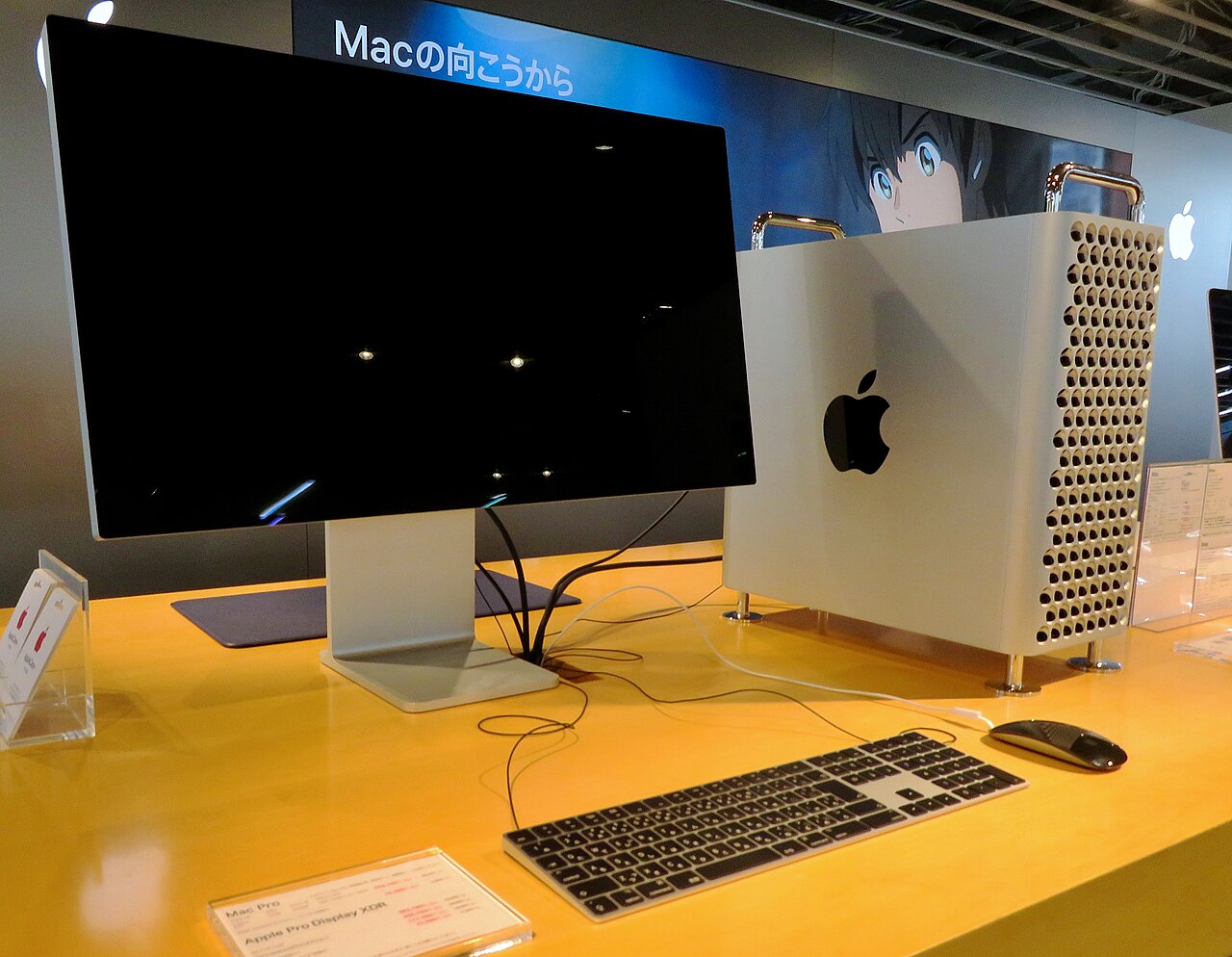
The Mac Pro 2019 — announced at WWDC 2019 and shipped in December 2019 — is the Apple product that carries the most symbolic significance beyond its specifications. It was the redesign that finally made peace with the Mac pro community after the 2013 “trash can” Mac Pro, it was the last Mac Pro with an Intel chip before the Apple Silicon era, and it was one of the products that John Ternus introduced at WWDC while VP of Hardware Engineering.
The context: the public 2017 “apology”
In April 2017, Apple did something rare for an Apple company: invited journalists to a meeting and publicly admitted that the 2013 Mac Pro — the black cylinder, “Pixar trash bin” — had been an architectural mistake. Its thermal architecture (two GPUs in a single airflow cone) made GPU upgrades impossible. Apple was stuck with a product that couldn’t evolve, and the pro community moved to Windows or Hackintosh alternatives.
Apple promised a new modular Mac Pro and a large-screen Pro display. The promise came with Phil Schiller. The delivery came with Ternus.
Mac Pro 2019 — the complete redesign
Everything in the 2019 Mac Pro was reactive to the 2013 mistake:
- Modular chassis with the entire chassis removable by a single lever twist.
- MPX (Mac Pro Expansion) slot system — custom GPU cards combining GPU + power + Thunderbolt on a single board.
- Up to 8 expansion slots, including two double MPX. The contrast with the 2013 Mac Pro (zero slots) is absolute.
- ECC memory up to 1.5 TB in 12 DIMM slots.
- Single-airflow thermal system with fans at every critical point.
- Aluminum chassis with a grid pattern that earned the “cheese-grater” nickname — a conscious reference to the original Mac Pro (2006), the “Power Mac G5” early generation. Apple was reconnecting with its own pro product history.
Launch price: $5,999 in base configuration. Maxed pro configurations reached $50,000+. It was a deliberately expensive product, deliberately for budget-equipped professionals, deliberately a statement that Apple still built serious workstations.
The WWDC 2019 presentation
Ternus took the WWDC 2019 stage — in June — to present parts of the Mac Pro 2019 alongside Phil Schiller (who led the presentation) and John Geleynse. It was Ternus’s second WWDC stage appearance after Brooklyn’s iPad Pro in 2018. The presentation was about 30 minutes total for Mac Pro + Pro Display XDR — the longest pro-product segment in a post-Jobs-era keynote.
The choice of putting Ternus on stage alongside Schiller (then Worldwide Marketing) was symbolic: engineering + marketing presenting together a pro product signaled that Apple was returning to treating pro Mac as institutional priority, not as niche.
Pro Display XDR — the display that ships with the Mac Pro
The Pro Display XDR debuted with Mac Pro 2019. $4,999 in the standard variant, $5,999 in nano-texture. The separate stand cost $999 — the detail that became press meme for months. Apple defended the price by pointing out that equivalent professional HDR displays (Sony BVM-HX310) cost $35,000+. By that math, Pro Display XDR was “cheap” relative to film/photo professionals.
The Mac Pro + Pro Display XDR combination was the most coherent pro setup Apple had sold in a decade. And it was the last pro Intel set Apple shipped — in 2020, M1 arrived and the Mac entered transition.
The Apple Silicon transition — Mac Pro 2023
The 2019 Mac Pro was the last Intel Mac Pro. In 2023, Apple launched the Mac Pro 2023 with Apple Silicon (M2 Ultra) in the same physical chassis. Same cheese-grater, same external modularity — but with the divergence: Apple Silicon doesn’t support PCIe external GPUs, so the 2023 Mac Pro has PCIe slots only for I/O and storage.
That architectural trade-off was controversial. See the tension: Apple Silicon won on performance per watt but lost on GPU modularity. In the Apple Silicon architecture, GPU is integrated in the SoC; there’s no discrete GPU. For professionals who depended on GPU upgrades (3D rendering, AI training), the 2023 Mac Pro was a use-case reformulation. The 2019 Mac Pro was, in retrospect, the last “traditional” Mac Pro — modular on every axis.
The historical place of Mac Pro 2019
In a Ternus-led hardware division that executed Apple Silicon, Vision Pro, and four new categories, the 2019 Mac Pro occupies a smaller position in revenue terms (Mac Pro was never a big Mac revenue contributor) but gigantic in pro brand repositioning terms. It was the product that told the pro community: “you still matter to us.”
Ternus’s hardware division made that delivery. It is the pro credential of Ternus’s mandate.
Specifications summary
- CPU: Intel Xeon W (8, 12, 16, 24, or 28 cores).
- RAM: up to 1.5 TB DDR4 ECC in 12 DIMM slots.
- GPU: Radeon Pro Vega II / Vega II Duo, expandable via MPX.
- Storage: up to 8 TB SSD (hardware encryption).
- Slots: 4 PCIe full-length, 2 half-length, 2 MPX.
- Connections: 4 Thunderbolt 3 (2 dedicated MPX), 2 USB-A, 2 10GbE.
- Launch: December 10, 2019.
- Launch price: $5,999.
See also
- M-series (Apple Silicon) — the succession of Mac Pro 2019.
- iPad Pro 2018 — Ternus’s first stage appearance, a year before Mac Pro 2019.
- Apple Vision Pro — the next pro category under Ternus.
- Biography — the engineer who introduced Mac Pro 2019 at WWDC.